Real estate listings are marketing documents. That's not a criticism — it's just what they are. Every listing is written to make the home sound as appealing as possible while staying within legal limits. If you don't know how to read between the lines, you'll waste weeks touring homes that don't fit and miss opportunities that do. Over 20 years of coastal Carolina real estate has taught me exactly what to look for and what to ignore.
Here's how to actually read a Charleston listing — whether you're shopping single-family homes, Charleston condos, or waterfront property — and pull out the real story hiding in plain sight.
Start With the Address, Not the Photos
Photos are staged, lit, and sometimes doctored. The address is the truth. Before you scroll to the pictures, pull up the address on a map. Look at the street. Look at what's next door. Look at what's across the street. Google Street View is your friend. A gorgeous kitchen doesn't matter if the home backs up to a highway or sits in a flood zone.
Read the Description Carefully — Especially What's Missing
Real estate descriptions follow a pattern. Impressive features get named. Boring or negative features get quietly skipped. What isn't mentioned matters as much as what is.
No mention of the roof age? It's probably older than the seller wants to advertise. No mention of HVAC? Same. Description dwells only on the kitchen and living room? The bedrooms may be smaller or dated. Every silence is a signal.
Watch for Coded Language
Certain phrases show up in listings for a reason. Learn to translate them:
- - "Cozy" often means small
- - "Character" often means older, quirky, potentially expensive to update
- - "Bring your vision" often means it needs significant work
- - "Investment opportunity" often means it's not immediately livable
- - "Motivated seller" often means priced above market and they know it
- - "Rare find" often means unique but with real trade-offs
- - "Original" often means unrenovated
- - "Handyman special" means gut renovation
- - "As-is" means the seller isn't fixing anything
None of these are automatically bad. But they tell you what you're really walking into before you drive out to a showing.
Look at Days on Market and Price History
Listing platforms show how long the home has been on the market and any price changes. This is one of the most useful pieces of data buyers ignore. A home listed at $650,000 for 90 days after starting at $725,000 tells you the seller has flexibility. A home at $650,000 that just came on the market yesterday is a different negotiation.
Multiple price drops usually mean the home was overpriced from the start. Long days on market in a hot neighborhood often points to a condition issue not visible in photos.
Study the Photos in Order
Photo order isn't random. Agents lead with the strongest images. If the exterior is photo 12 out of 15, the exterior probably isn't the strongest feature. If the kitchen is photo 1, that's the home's selling point.
Look at what's not photographed. No bathroom photos? They're probably dated. No garage or basement photos? Same. Skipped rooms are almost always the ones with issues.
Check the Photo Details
Wide-angle lenses make rooms look bigger. Look for shots that show the same room from multiple angles — those give you a truer sense of size. Watch for reflection points — mirrors and windows can reveal what a stager was trying to hide. Notice what's not in frame — the corner of a room, an adjacent hallway, a window that only shows a fence six feet away.
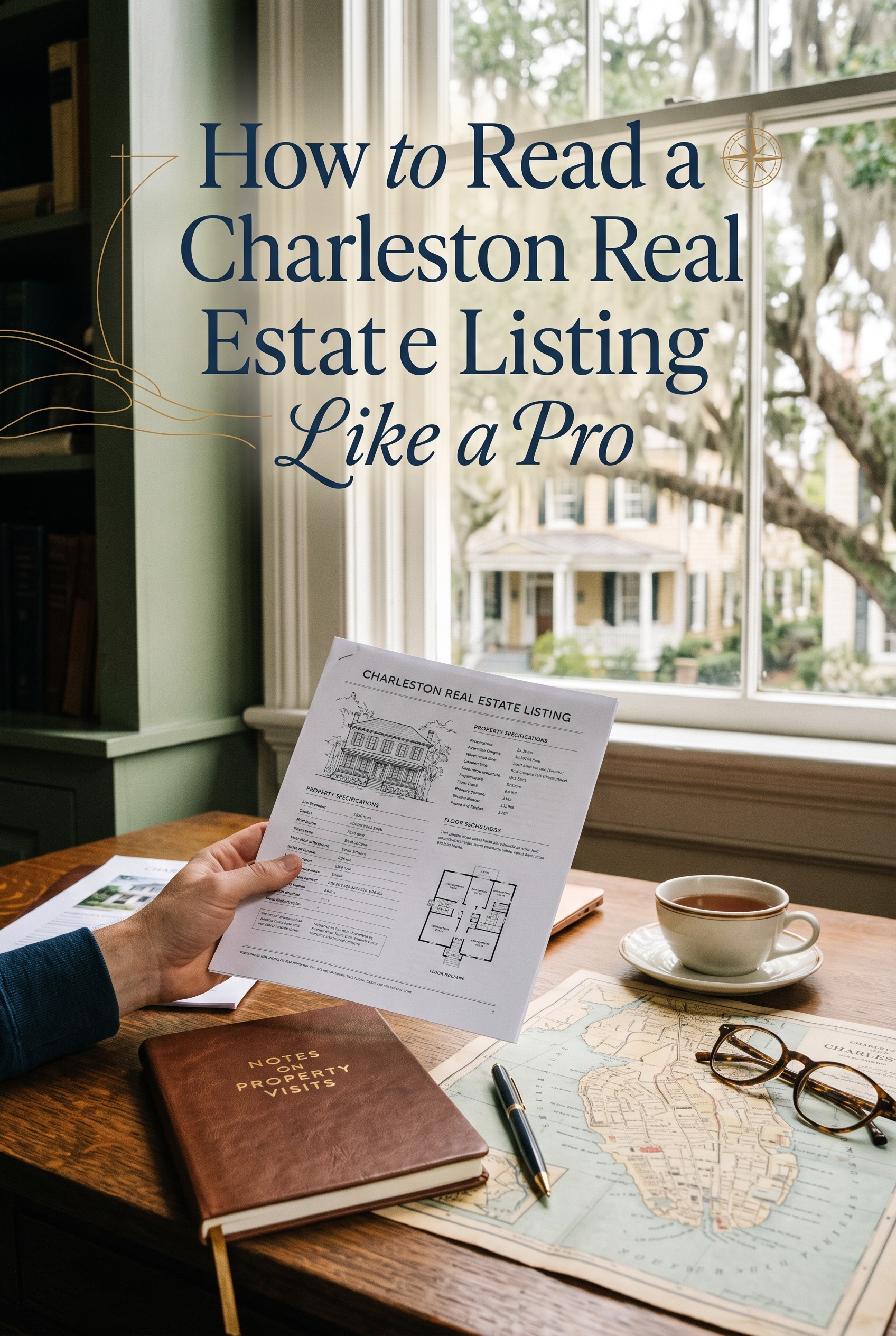
Read the Property Details Section
Below the description, most listings include a specs section. Read every line.
Year Built
Older homes in coastal Charleston often need updated systems and hurricane-code retrofits. A 1970s ranch in Byrnes Down and a 2018 build in Nexton are different investment propositions.
HOA Fees
Included or not? If included, at what level? Some Charleston-area HOAs are minimal. Others run several hundred dollars a month. Master-planned communities often have multiple HOA layers.
Property Taxes
The listing shows current taxes. Remember these are usually based on the current owner's assessment. If the current owner has the 4% owner-occupied rate and you'll use it as a second home at 6%, your taxes will be dramatically higher.
Flood Zone
Sometimes listed. Often not. Ask your Realtor to confirm the specific FEMA zone before falling in love with the home.
Square Footage
Confirmed by the county or estimated by the listing agent? These can differ meaningfully. Also watch for finished versus unfinished square footage.
Neighborhood Context Matters
The same home in different neighborhoods trades at wildly different prices. A well-priced 3-bedroom in Riverland Terrace is a different opportunity than the same home in a less-established neighborhood. A rural property in Crowfield Plantation lives differently than one in downtown.
When a home looks too good relative to comparable listings, dig into why. Sometimes it's a genuine bargain. More often it's telling you something the photos don't show.
Cross-Check With Comparable Recent Sales
The listing price is aspirational. Recent comparable sales are reality. Ask your Realtor to pull 3-5 comps that closed in the last 60-90 days in the same neighborhood. If the listing price is significantly above the comps, the seller may be testing the market. If it's below, the home may have known issues.
What Great Listings Look Like
A well-written, well-photographed listing usually reflects a well-cared-for home and a serious seller. Great listings show every important room, describe recent updates specifically, disclose HOA and flood details, and price at market. When you find one, move quickly — other buyers can read too.
Red Flags That Deserve a Call to Your Realtor Before You Tour
- - "Sold as-is" with dated interior photos suggests structural or system issues
- - Vague descriptions with heavy language leaning on lifestyle rather than the home itself
- - No exterior photos or only aerial drone shots
- - Description mentions HOA "for information" but no HOA fee listed
- - Property has been listed multiple times over recent years
None of these disqualify a home. They just deserve a conversation before you drive across the metro.
Strategy for Charleston Buyers
Build your list of candidate homes from the descriptions and specs, not just the photos. Have your Realtor pull comps and flag any red flags before you tour. Prioritize showings on the strongest candidates rather than trying to see everything. And when you find a great listing that's priced right, move fast — Charleston moves too quickly to shop leisurely on the best inventory.
Key Takeaways
Charleston real estate listings are marketing documents, and reading them well saves buyers real time and money. Study the address before the photos. Notice what's missing from descriptions and photo sets. Learn the coded language. Check days on market and price history. Cross-reference specs and neighborhood comps. Approach listings with a healthy skepticism and you'll surface the strongest opportunities faster than buyers relying on gut and eye candy.