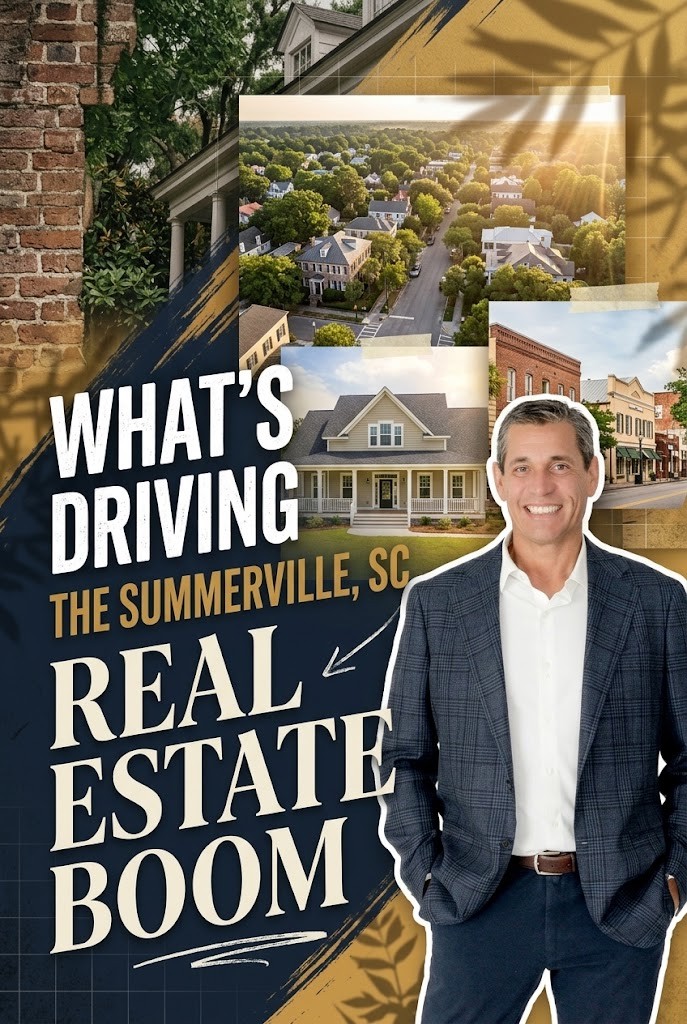
Summerville went from a sleepy suburb with azaleas and a historic district to one of the fastest-growing towns in South Carolina, and most people in the Charleston area underestimated how fast it was going to happen. If you're thinking about buying, selling, or moving to Summerville, here's what's actually driving the growth — and what it means for property values over the next five years.
I've been watching this market closely for 20+ years. Summerville was always going to grow. What surprised me is the pace.
The Short Version
Three forces compounded: Boeing and the aerospace corridor hiring in North Charleston drove housing demand north and west; master-planned communities like Cane Bay Plantation, Nexton, and Carnes Crossroads opened up thousands of lots at prices that worked for working families; and the pandemic flipped remote work from "nice to have" to "normal", letting buyers trade a tight downtown condo for a four-bedroom with a yard 25 miles out.
Then I-26 kept filling up, 526 kept crawling, and buyers kept making the same math work.
What's Actually Fueling It — In Order
1. Price Per Square Foot
Summerville still delivers more house for the money than any other Charleston-area submarket of comparable school quality. A buyer priced out of Mount Pleasant or Daniel Island often finds a newer, larger, better-equipped home in Summerville for 25 to 40 percent less.
2. Master-Planned Communities With Amenities
Nexton, Cane Bay, Carnes Crossroads, The Ponds, and Pine Forest all offer resort-style amenities — multiple pools, pickleball, trail systems, lakes, dog parks, event lawns, YMCA partnerships. Buyers from Charlotte, Raleigh, or Northeast metros expect this level of community design and Summerville delivers.
3. Job Growth North of 526
Boeing's North Charleston campus, Volvo's Ridgeville plant, Google's data center, and the ongoing expansion of the Moncks Corner and Goose Creek industrial corridors all pull commute patterns toward Summerville. The 15 to 25 minute drive to Boeing is a lot of why those lots sold out so fast.
4. Schools Keep Attracting Families
Dorchester District 2 has a strong academic reputation. Berkeley County schools serving Cane Bay and Carnes have improved steadily. For families relocating, the school zone is often the first filter — and Summerville's zones hold up.
5. New Construction Keeps Coming — But Pace Is Finally Slowing
For years builders couldn't open new sections fast enough. Lennar, Pulte, DR Horton, Toll Brothers, Lowder, Dream Finders — they've all been active. In the last 18 months, with higher rates slowing absorption, pace has normalized. For buyers, that means builder incentives — rate buydowns, closing cost credits, upgraded packages — are back on the table in a real way.
 What This Means for Buyers Right Now
Summerville is not the "easy win" it was five years ago. Prices appreciated hard. Interest rates are higher. Insurance costs climbed. But here's what's still true:
- - New construction incentives make the effective payment often cheaper than resale
- - Master-planned community amenity values are real and translate to resale premium
- - Commute times to Boeing, downtown, and the airport are predictable
- - Rental demand remains strong, which supports exit value for investors
What I tell buyers now: Summerville is still a strong buy, but you need to buy the right neighborhood. Not every section of every subdivision ages at the same rate. Older established pockets of Summerville, the premium sections of Nexton, and the Carnes Crossroads town center lots are performing differently than the farthest-back phase of a brand-new subdivision 20 minutes from any amenity.
What This Means for Sellers Right Now
If you bought in Summerville between 2018 and 2022, you probably have real equity. But you're now competing with new-construction incentives, and buyers are more selective than they were two years ago. Pricing has to be sharp. Condition has to be clean. Presentation matters more than it did when every listing had multiple offers.
What's working: tight pricing, pre-listing inspections, strong photography, and short decision windows for offers rather than a drawn-out "best and final."
Where Summerville Goes From Here
The growth story has runway. Infrastructure is catching up (the Nexton Parkway and I-26 widening progress matter), employers are still expanding, and the lifestyle appeal has only strengthened. What I'm watching: traffic, school capacity, and insurance costs. If those three get managed, Summerville's trajectory holds. If any of them slip badly, growth absorbs it but spreads toward Moncks Corner and Ridgeville.
Key Takeaways
- - Summerville's growth is driven by job corridors (Boeing, Volvo, aerospace), price per square foot, and master-planned amenity-rich communities
- - Nexton, Cane Bay, Carnes Crossroads, and The Ponds remain the strongest community brands in the submarket
- - New construction incentives are back — rate buydowns, closing cost credits, upgraded packages — and often beat resale on effective payment
- - Dorchester District 2 schools remain a major draw for relocating families
- - Sellers who bought between 2018–2022 hold real equity, but pricing discipline and presentation matter more than they did two years ago
- - Not all Summerville neighborhoods appreciate at the same rate — buying the right section matters as much as buying the right town
- - Infrastructure (traffic), school capacity, and insurance costs are the three variables to watch going forward
About Greg Harrelson
Greg Harrelson is Broker/Owner of Century 21 The Harrelson Group and owner of Century 21 Expert Advisor in the Charleston market. With more than 20 years in coastal Carolina real estate and 15,000+ homes and condos sold or partnered on, Greg leads roughly 500 agents across the Grand Strand and Charleston. He tracks every submarket in the region including Summerville, Nexton, Cane Bay, and Carnes Crossroads.